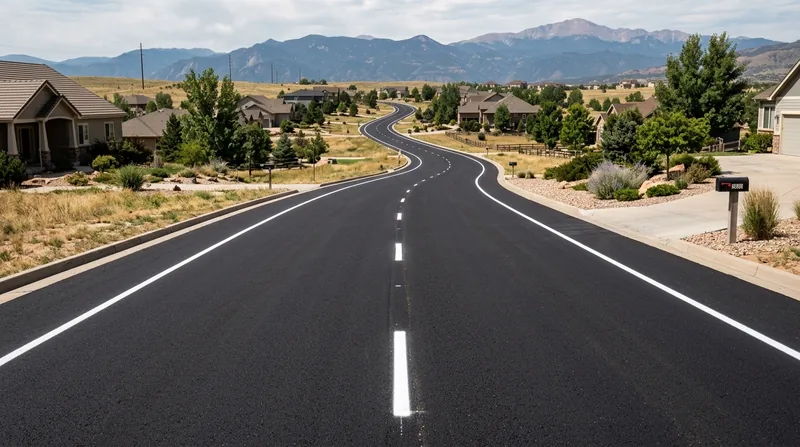




Private Road & HOA Paving in Colorado Springs means building roads that hold up to the hard ground and harder winters of the Front Range. Subdivisions sprawling north and east across El Paso County face clay that heaves, freeze-thaw cycles that crack bases, and runoff that carves ruts into uncompacted shoulders. Whether you manage a master-planned community, a private HOA road, or a subdivision entrance, the road has to drain, it has to flex when the bentonite swells, and it has to stay flat under delivery trucks and daily traffic. We grade and compact the base to the 30-inch frost line, lay hot mix asphalt with proper aggregate, and pitch the road so water clears the rolling plains grade instead of pooling in the middle. That is how asphalt actually holds up here. This page covers what private road and HOA paving involves, what it costs, and how to hire the right contractor for your subdivision or community.
Why Private Road & HOA Paving Matters in Colorado Springs
The terrain and climate of Colorado Springs demand more from a private road than asphalt in a flat, temperate zone. Thirty inches of frost depth means the base has to go deep. Dozens of freeze-thaw cycles a year work on that base all winter, lifting and settling it. Swelling bentonite clay under many older subdivisions heaves slabs and cracks edges. Runoff from sudden summer hailstorms and spring snowmelt has to leave the road surface instead of pooling in the center, where it soaks the base and ruins it. A properly built private road handles all of this. A poorly built one fails in three to five years and becomes a liability and a money pit.
- Frost depth in Colorado Springs is 30 inches, which means the asphalt and base must be engineered and compacted to that depth to prevent heave and settling.
- Clay-heavy soils in many subdivisions swell when wet and shrink when dry, which cracks slabs and opens seams unless the base is built to move with the ground.
- Pitch and drainage design prevent water from pooling on the road surface, which is the single biggest cause of premature failure in the Colorado Springs area.
- Proper edge compaction and aggregate base prevent raveling and shoulder failure, which is how subdivision roads become rutted and cracked at the margins.
- A road built to these standards will carry heavy traffic and weather 15 to 20 years; one built to a budget will fail in 3 to 5 and cost far more to repair.
Choosing the right contractor and the right spec is the difference between a road that works and one that becomes a legal and financial problem for your HOA or property management.
Key info: Colorado Springs municipal codes and HOA architectural standards govern what materials, thickness, and drainage requirements apply to your private road. Some master-planned communities require specific asphalt grades or recycled content; others allow tar and chip or gravel alternatives. Always verify with your local building department and your HOA architectural review board before engineering and design work begins. See the Colorado Department of Transportation pavement design guidance for state-level context.
How We Build Private Roads in Colorado Springs: The Process
A private road is not a driveway. It has to carry multiple vehicles, snow plows, delivery trucks, and emergency access. The base prep is the critical difference. We start by grading and compacting the subgrade, removing any soft or organic material and bringing in engineered fill that will not move. We then lay a compacted aggregate base, usually 4 to 6 inches of crushed stone, and proof roll it with heavy equipment to confirm it will hold traffic without settling. Once the base is solid, we lay hot mix asphalt in lifts, usually 2 inches on the first course and 1.5 to 2 inches on the top course, compacting each lift to density before the next one goes down. The road is pitched to shed water, and edges are compacted as hard as the center so shoulders do not ravel and crack.
- We grade the subgrade and remove any clay, silt, or organic material that will not compact or will move when wet.
- We bring in engineered fill or native material suitable for compaction and lay it in lifts, compacting each one to a specified density.
- We install a compacted aggregate base, usually 4 to 6 inches, and proof roll it with heavy equipment to confirm it will not settle under traffic.
- We lay hot mix asphalt in two lifts, compacting each one fully before the next goes down, and pitch the road surface so water runs off instead of pooling.
- We compact edges and shoulders as hard as the center so the road does not ravel at the margins or crack from edge traffic.
- We coordinate with Colorado 811 for utility locates before any excavation or grading begins, which is required by law.
This is the work that actually holds up in Colorado Springs. Shortcuts on base prep, compaction, or thickness show up as rutting, alligator cracking, and edge failure within two to three years.
Local example: A typical HOA subdivision entrance in Monument or Woodland Park, 300 to 500 linear feet with a 20-foot width, usually requires 4 to 6 inches of compacted aggregate base, 3.5 to 4 inches of hot mix asphalt in two lifts, and grading and compaction work that takes 3 to 7 days depending on weather and access. The cost reflects the base work, not just the asphalt, because the base is what makes the road hold up to the freeze-thaw cycles and clay movement that dominate this region.
| Approach | Description | Best for |
|---|---|---|
| Full-depth asphalt paving | Grade, compact aggregate base to 30-inch frost depth, lay 3.5 to 4 inches hot mix asphalt in two lifts, compact fully, pitch for drainage. | New private roads, subdivision entrances, HOA roads carrying regular traffic and snow removal equipment. |
| Asphalt overlay on existing base | Mill or remove top 1 to 2 inches of existing asphalt, clean the base, lay new 2 to 3 inches hot mix asphalt, compact fully, pitch for drainage. | Private roads with a sound base but a worn or cracked surface; extends life 10 to 15 years if the base is not failing. |
| Recycled asphalt millings | Lay 4 to 6 inches recycled asphalt millings, compact with water and vibratory roller, re-compact annually, top-dress as needed. | Private roads in rural subdivisions, secondary HOA roads with light traffic, budget-conscious developments; requires annual maintenance. |
| Tar and chip (chip seal) | Spray hot liquid asphalt on existing base or aggregate, roll in stone chips, compact, allow to cure 2 to 3 weeks before traffic. | Secondary roads, light-traffic private lanes, rural driveways; lower upfront cost but shorter life than hot mix asphalt. |
| Gravel and crushed stone | Grade, lay 6 to 8 inches compacted aggregate base, crown for drainage, maintain with annual raking and top-dressing. | Very low-traffic private lanes, seasonal roads, temporary construction access; lowest upfront cost, highest maintenance. |
Private Road & HOA Paving Cost in Colorado Springs: What to Expect
Private road and HOA paving cost in Colorado Springs depends on length, width, existing base condition, soil type, and whether you are building from scratch or overlaying an existing road. A new private road with full-depth base prep and hot mix asphalt starts at around $15,000 to $25,000 for a typical HOA entrance or short subdivision road (300 to 500 linear feet, 20-foot width). Longer roads, roads on steep grades, roads with poor drainage or clay-heavy soils, and roads requiring milling or full removal of failed asphalt cost more. Recycled asphalt millings or tar and chip cost less upfront but require regular maintenance and may not hold up to heavy traffic or aggressive snowplow use.
The biggest cost drivers are base prep, soil conditions, and drainage. If the subgrade is clay-heavy or has poor drainage, you may need thicker base prep, imported fill, or drain rock to prevent failure. If the road is on a grade or in a rolling terrain, you may need grading and compaction work that adds cost. If an existing road is being replaced, milling and removal add cost but may be required by the municipality or the HOA architectural standards.
We provide a written estimate with tonnage specs, compaction requirements, and thickness details so you know exactly what you are paying for and why. A free estimate takes 24 to 48 hours and includes a site walk, measurements, soil observations, and a clear breakdown of base prep, asphalt, and finishing work. Visit our pricing page for more detail on what affects cost, or call (719) 355-8474 to schedule your estimate.
What to Look for When Hiring a Private Road Paving Contractor Near Me in Colorado Springs
Hiring the wrong contractor for a private road is expensive. A road built to a budget fails in 3 to 5 years and becomes an HOA liability and a legal problem. A road built to spec holds up 15 to 20 years. Here is how to choose a contractor and protect yourself.
- Ask the contractor to show you written estimates that include base depth, aggregate type and tonnage, asphalt thickness, compaction specs, and drainage details so you can compare apples to apples.
- Ask whether the contractor is fully insured and ask to see a certificate of insurance that covers general liability, property damage, and workers compensation for the scope of work.
- Check references from other HOAs or private road projects in the Colorado Springs area and ask about base prep quality, drainage, and how the road has held up over time.
- Verify that the contractor is local and has verifiable ties to Colorado Springs; the paving trade has a history of itinerant crews offering unsolicited deals on leftover asphalt, which is a red flag.
- Confirm that the contractor understands Colorado 811 utility locates and local permitting rules, which vary by municipality and HOA; some jurisdictions require permits for driveway aprons, curb cuts, or impervious surface limits.
- Ask whether the contractor has experience with the specific soil and climate challenges of Colorado Springs, including clay movement, frost depth, and freeze-thaw cycles.
- Get at least two or three estimates before deciding, and be skeptical of a price that is significantly lower than the others, as it usually means a shortcut on base prep or compaction.
If you are ready to move forward, contact us for a free estimate and we will walk your private road or HOA property, answer your questions, and give you a clear, written proposal with no obligation to book.
Private Road & HOA Paving in Colorado Springs: Pricing Guide
| Service | Price | Details |
|---|---|---|
| New private road or HOA entrance (300-500 linear feet, 20-foot width) | Starting at $15,000 | Full-depth base prep, 4-6 inches compacted aggregate, 3.5-4 inches hot mix asphalt, grading and drainage design included |
| Longer private road or subdivision road (800+ linear feet) | Starting at $25,000 | Pricing scales with length, width, and base condition; soil type and drainage requirements are the largest cost variables |
| Overlay on existing road with sound base | Starting at $8,000 | Mill or remove top layer, lay 2-3 inches new hot mix asphalt, extends road life 10-15 years if base is not failing |
| Recycled asphalt millings or tar and chip alternative | Starting at $5,000 | Lower upfront cost but requires annual maintenance and raking; suitable for low-traffic secondary roads only |
| Complex or large-scale job (steep grade, poor drainage, clay soils, full removal required) | On estimate | Site-specific conditions require field walk and soil observation before price can be given; complexity drives base depth and grading cost |
| Estimate and consultation | Free | Response within 24 hours at (719) 355-8474; includes site walk, measurements, tonnage specs, and written proposal |
Indicative pricing, the exact cost depends on square footage, finish, and site access. Free personalized estimate within 24h at (719) 355-8474.


